
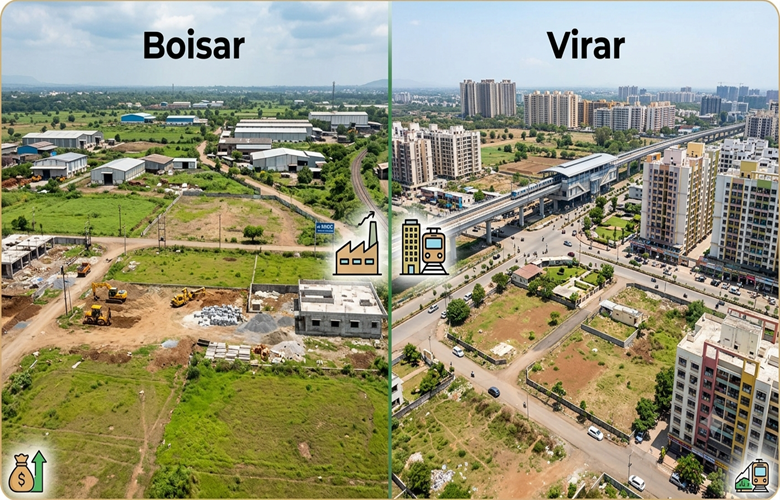
If you have been hunting for land near Mumbai, you have probably had this exact argument with yourself, or with your family, at least once. Boisar vs Virar feels like a choice between Virar’s familiarity and Boisar’s growth potential. So, which one actually deserves your money?
The short answer: it depends on what you are buying land for. If you want to live in a flat within the next twelve months, Virar wins. If you want to own land, hold it, and let infrastructure do the heavy lifting on price, Boisar is the more interesting market right now. The rest of this article explains why, without sugar-coating either side.
I will keep the language plain. No jargon, no vague promises. Just how the two markets compare on price, connectivity, growth drivers, and what your money actually gets you.
First, Understand What You Are Comparing
Virar and Boisar sit on the same Western Railway line, both inside the Mumbai Metropolitan Region, both in Palghar district’s orbit. On a map, they look like neighbors. As property markets, they are at completely different stages of their life.
Virar is a mature suburb. It went through its big growth phase years ago. Today it is dense, apartment-dominated, and largely built out along the station belt. Most of what gets sold in Virar is a flat in a high-rise, because open land near the station is scarce and expensive. When land does come up, it is usually a small parcel, often with unclear titles, and priced for what Virar already is, not for what it might become.
Boisar is the opposite. It is still early. Land is available in large, clean parcels. Prices reflect a town that is being built, not one that is finished. And crucially, the biggest infrastructure projects in western India are landing in and around Boisar, not Virar.
That single difference, mature market versus early market, drives everything else in this comparison.
The Case for Virar
Let me be fair to Virar first, because it genuinely has strengths.
It is livable today. Schools, hospitals, markets, malls, local trains every few minutes into Mumbai. If you buy in Virar, you don’t have to wait for anything. The ecosystem exists.
Rental demand is real. Virar has a large working population that commutes to Mumbai daily. You can rent out a flat there fairly quickly. Land, however, earns no rent, and buildable land in Virar is hard to find at a sane price.
Liquidity is better. Because the market is established, there are always buyers. If you need to exit in two or three years, Virar lets you sell faster.
The problem? You are paying full price for a market that has already grown. Virar’s big appreciation happened when it went from a sleepy town to a commuter suburb. That phase is over. From here, Virar grows at the pace of a mature suburb: steady, slow, unspectacular. And for a land buyer specifically, Virar is frustrating. Clean, titled, large plots barely exist near the station, and what exists is priced so high that the rental or resale math rarely works.
The Case for Boisar
Now the other side. Boisar’s case rests on three infrastructure projects, and none of them are speculation. All three are sanctioned, funded, and under construction.
1. The Mumbai–Ahmedabad Bullet Train. Boisar gets its own bullet train station. Think about what that means for a town of this size. When the corridor opens, Boisar stops being “far” in any meaningful sense. Distance stops mattering; buyers pay for travel time. Virar, notably, is not a bullet train stop.
2. Tarapur MIDC. This is one of Maharashtra’s largest industrial belts, and it sits right next to Boisar. Thousands of people already work there. Industrial employment is what creates genuine, long-term housing demand, the kind that does not evaporate when interest rates move.
3. Vadhavan Port and the DMIC corridor. A major new port is being built about 25 km from Boisar, and the Delhi–Mumbai Industrial Corridor passes roughly 9 km away. Ports and freight corridors pull warehousing, logistics parks, and jobs into their surrounding towns. Boisar sits directly in that pull zone.
No suburb in the MMR has this specific combination: a bullet train station, an established industrial belt, an upcoming port, and a freight corridor, all within a 25 km radius. Virar has none of these as direct drivers. That is not a knock on Virar; it is simply not where this wave of investment is going.
The honest downside of Boisar: it is still developing. Social infrastructure, restaurants, big malls, and premium schools are thinner than Virar’s. If you buy land in Boisar, you are buying the next five to ten years, not the next twelve months. Anyone who tells you otherwise is selling, not advising.
Price: Where the Comparison Gets Interesting
Here is the practical reality. In Virar, a decent 1 BHK or 2 BHK flat eats up the same budget that buys you an actual plot of land in Boisar.
Take a concrete example. At Birla Mrida, Birla Estates’ plotted township in Boisar, plots start at ₹55 Lakhs* for a 1,200 sq. ft. plot. Do the simple division, and you are paying roughly ₹4,500-4,600 per sq.ft. of land, inside a gated, RERA-registered township, with roads, services, and landscaping built in.
Now think about what ₹55 lakhs buys in Virar. In most cases, a compact apartment where the “land” component of what you own is a fractional, undivided share you will never see or use. The building depreciates from the day you get the keys. The land under it appreciates, but you own a sliver of it.
That is the core financial difference between the two markets:
- In Virar, your money buys mostly construction. Construction ages, needs maintenance, and loses value over time.
- In Boisar, the same money buys mostly land. Land does not depreciate, needs no repairs, attracts no society maintenance politics, and appreciates as the surrounding area develops.
For a pure investor, that distinction matters more than almost anything else.
ROI and Growth Potential: Boisar vs Virar
Nobody can promise you a percentage return, and you should walk away from anyone who does. But we can compare the logic of returns in each market, which is what serious investors actually do.
How returns work in Virar
Virar’s growth engine was Mumbai’s workforce migrating westward. That engine has largely done its work. Prices now move with general market cycles: a few percent up in good years, flat in slow ones. A flat also generates rent, which adds to returns, but rental yields in the outer suburbs are modest, and maintenance, property tax, and repairs eat into them. Virar today is a preservation market. Your capital is safe, liquid, and slow.
How returns work in Boisar
Boisar’s growth engine has not fired yet. The bullet train station, the port, and the corridor are all still under construction. Land markets historically re-rate in steps, and the steps happen when infrastructure moves from “announced” to “visible” to “operational.” Boisar is currently between the first and second step. Buyers entering now are entering before the re-rating, not after it.
That is what makes Boisar a growth market. The risk is time: you must be able to hold. The reward is that early land in an infrastructure corridor has the widest gap between entry price and eventual value. Virar itself is the proof. People who bought land in Virar twenty years ago, before it matured, made the kind of returns that flat buyers there today will never see. Boisar is at that earlier point on the same curve.
A simple way to decide
Ask yourself one question: do I need this money or this property in the next two years?
- If yes, choose Virar, or honestly, choose a liquid financial asset instead.
- If no, and you can hold for 5 years or more, Boisar’s risk-reward is clearly better for a land buyer.
Pros and Cons at a Glance
Virar: Pros
- Fully developed social infrastructure, ready to live in today
- Strong rental demand from Mumbai commuters
- Faster resale because the buyer pool is large
- Frequent local trains and an established station ecosystem
Virar: Cons
- The big appreciation phase is behind it
- Clean, titled land parcels are rare and overpriced
- Your budget buys construction, not land
- High density, congestion, and stretched civic services
- No direct benefit from the bullet train, Vadhavan Port, or DMIC
Boisar: Pros
- Entry prices still reflect an early-stage market
- Direct beneficiary of the bullet train station, Tarapur MIDC, DMIC, and Vadhavan Port
- Large, clean, RERA-registered land parcels are actually available
- Your money buys land, the only part of real estate that appreciates
- Industrial employment base already exists, so demand is not purely speculative
Boisar: Cons
- Social infrastructure is still catching up to Virar’s
- Returns need patience; this is a 5 to 10 year hold, not a flip
- Fewer buyers today mean slower resale in the short term
- Standalone land purchases (outside organized townships) carry title and access risks if you do not do your homework
Not All Boisar Land Is Equal: Township Plots Vs Random Parcels
This is where most first-time land buyers go wrong, so read this part carefully.
The Boisar opportunity does not mean any piece of land in Boisar is a good buy. Standalone agricultural parcels bought through local brokers come with real risks: unclear titles, no road access, no drainage, disputes, and conversion headaches. Cheap land you cannot use or sell isn’t cheap. It is dead money.
The safer route is a plotted township by a large, accountable developer, and this is exactly the gap Birla Mrida fills in Boisar. A few facts about it, so you can judge for yourself:
- Developer: Birla Estates, part of the Aditya Birla Group. For most buyers, that name answers the two questions that matter most with land: will the project be completed as promised, and will the paperwork be clean
- Scale: A 68-acre master layout with 56 saleable acres and 539 residential plots, designed by Suvidh Shukla Architects.
- RERA: Registered with MahaRERA under PP1240002552953, which means the layout, timelines, and commitments are on regulatory record, not just on a brochure.
- Plot sizes: 1,200 to 9,000 sq. ft., so it covers everything from a first plot to a large villa parcel you can hold long-term.
- Pricing: Starting at ₹55 Lakhs* for the 1,200 sq. ft. size, with a 1 Lakh booking amount and a 30:70 payment plan.
- Amenities: A 30,000 sq. ft. clubhouse, 4.75 acres of green amenities, a public cricket ground, and 30+ facilities including a pool, gym, co-working space, pickleball and box cricket courts, a skating rink, and a pet park. The whole layout is planned as a walkable green neighbourhood.
- Location: Umroli Railway Station 2 km, the upcoming Boisar Bullet Train Station 4 km, Tarapur MIDC 5 km, DMIC 9 km, and Vadhavan Port 25 km. Schools, D-Mart, Reliance SMART Bazaar, and hospitals all sit within a 4-7 km ring.
- Possession: 2028-2029, which lines up neatly with the timeline of the infrastructure the area is waiting on.
How does it compare with other options?
Put the alternatives side by side and the picture gets clearer:
- A Virar apartment at a similar budget gives you a depreciating flat, monthly maintenance, and a fractional land share, in a market that has already had its growth run.
- A standalone Boisar land parcel may look cheaper per square foot, but you carry title risk, access risk, and development cost alone, with no gated infrastructure and no brand standing behind the paperwork.
- Smaller local plotted schemes in the Palghar belt exist, but few offer this combination of a national developer, MahaRERA registration, a 68-acre master plan, and a full amenity layer. With land, who you buy from matters almost as much as where you buy.
Birla Mrida packages the Boisar growth story with the safety net usually reserved for apartment buyers: a branded developer, RERA registration, and a professionally managed layout. For a first-time land investor, that combination removes most of the reasons land investments go wrong.
So, Boisar or Virar? The Verdict
Here is my honest read after laying it all out.
Choose Virar if you need a home to move into within a year, want rental income immediately, or may need to sell within two to three years. Virar is the sensible, low-drama choice for end use.
Choose Boisar if you are investing, can hold for five years or longer, and want your money in land rather than concrete. The bullet train station, Tarapur MIDC, DMIC, and Vadhavan Port form a growth stack that Virar simply lacks. And within Boisar, an organised, RERA-registered township like Birla Mrida is the way to capture that growth without taking on the classic risks of raw land.
Twenty years ago, Virar was the “too far” bet that made early buyers wealthy. Boisar is having its version of that moment now, except this time the infrastructure is not a hope. It is under construction, with a station 4 km from the project gate.
For current plot availability, sizes, and pricing at Birla Mrida, you can enquire directly on the project page and get the latest details before the initial inventory moves. With 539 plots on a first-come, first-served basis, the better-positioned plots go first.
Read more of my blogs: https://www.birlamridaplotsboisar.com/blog/
FAQs: Boisar vs Virar Land Investment
Is Boisar better than Virar for land investment?
For land specifically, yes, in most cases. Virar has very little clean, titled land left near the station, and what exists is priced for a mature market. Boisar offers large, RERA-registered plotted developments at early-stage prices, with the bullet train, Tarapur MIDC, DMIC, and Vadhavan Port driving future demand.
Why is Virar more expensive than Boisar?
Virar developed earlier. Its prices already include decades of growth, full social infrastructure, and dense demand from Mumbai commuters. Boisar’s prices still reflect a developing town, which is exactly why the upside for land buyers sits there rather than in Virar.
Is it risky to buy land in Boisar?
Buying random standalone parcels through local brokers carries title, access, and conversion risks. Buying within a MahaRERA-registered township from a branded developer removes most of those risks. Birla Mrida, for example, is registered under MahaRERA No. PP1240002552953 and developed by Birla Estates of the Aditya Birla Group.
What is the starting price of plots at Birla Mrida Boisar?
Plots start at ₹55 Lakhs* for the 1,200 sq. ft. size, with sizes going up to 9,000 sq. ft. The booking amount is ₹1 Lakh, on a 30:70 payment plan. The starting figure is indicative and excludes GST, stamp duty and registration charges.
How far is Birla Mrida from the Boisar Bullet Train Station?
About 4 km. Umroli Railway Station is even closer at 2 km, Boisar Railway Station is 5 km away, and Tarapur MIDC is 5 km from the project.
Can I build a house on a plot at Birla Mrida?
Yes. These are residential plots within a gated, master-planned township, with internal roads, services, and landscaping developed by Birla Estates. You own the land outright and can build when you choose, or simply hold the plot as an investment.
When is possession expected at Birla Mrida?
Possession is slated for 2028-2029, which broadly aligns with the timeline of the major infrastructure projects around Boisar.
What ROI can I expect from land in Boisar?
No honest answer includes a fixed percentage. What can be said is this: land in early-stage infrastructure corridors has historically outperformed apartments in mature suburbs over long holding periods, because land does not depreciate and re-rates when infrastructure becomes operational. Boisar fits that pattern; Virar no longer does.

Considering Birla Mrida, Boisar, Palghar?
Plot sizes, pricing and payment plan on request.
Related reading

Why Plotted Communities Are the Smarter Choice for Buyers Who Want More Space
Plotted Communities Work for Buyers, something apartments cannot: the freedom to build a home designed around their actual life, not a builder’s floor plan. In planned…
Read more →
Boisar Plot Investment 2026: Hold Land or Build a Home?
Buy plots in Boisar as an Boisar Plot Investment 2026 if you can pay mostly from savings and hold for 5 years or more. Build your…
Read more →
1 comment